Rajasthan has a way of making you feel like you have stepped into a painting. The light is different here. The colours are more saturated, the architecture more audacious, the sense of history more immediate. And within Rajasthan, Udaipur is perhaps the most beautiful of all its cities, the one that earns its nickname the City of Lakes and makes you understand completely why it has that name.
Udaipur sits around Lake Pichola like a setting around a jewel. The City Palace, one of the largest palace complexes in Rajasthan, rises above the lake in a series of courtyards, terraces, towers, and zenanas that took over 400 years to build across successive maharanas. Walking through it is like moving through time, each corridor carrying a different era of the Mewar dynasty, each window framing a different view of the water and the city below. The 17th century Jagdish Temple, dedicated to Lord Vishnu and covered in extraordinary stone carvings, sits at the head of the main bazaar and is one of the finest examples of Indo Aryan architecture in the region.
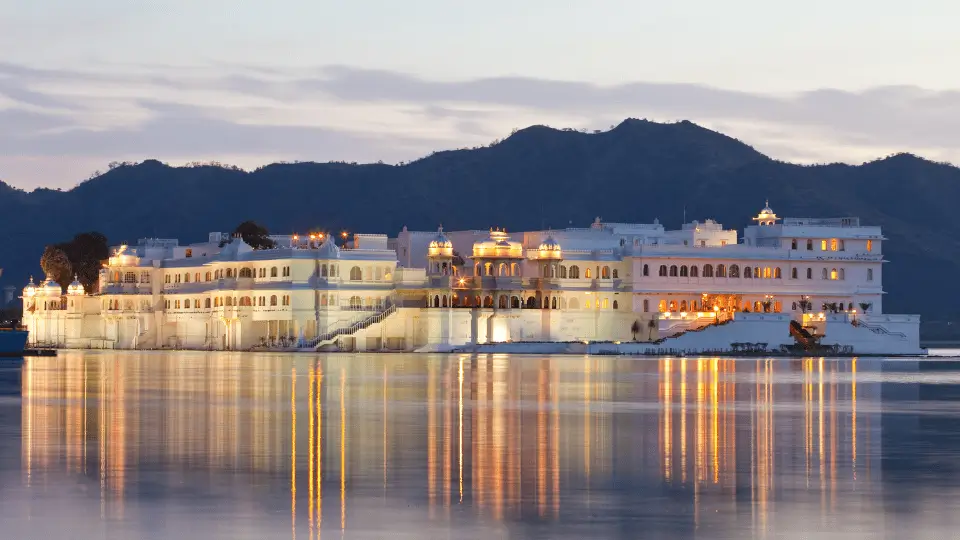
But Udaipur is not only its monuments. The city lives in its lanes, its ghats, its havelis, its small workshops where artisans paint miniatures with brushes made from squirrel hair, and its evening performances of traditional Rajasthani folk music and dance at Bagore ki Haveli on the lake’s edge. A heritage walk through the bylanes of the old city and a visit to Saheliyon ki Bari, the garden of the maidens built by Maharana Sangram Singh for the royal ladies of the court, give you a Udaipur that goes well beyond the postcard version. And a boat ride on Lake Pichola at golden hour, with the Lake Palace floating white in the middle of the water and the Aravalli hills turning amber in the distance, is one of those simple, perfect travel moments that needs nothing added to it.
Jawai is a different world entirely, and that contrast is exactly what makes this combination so compelling. Located in the Pali district about three hours from Udaipur, Jawai is one of the most extraordinary wildlife destinations in India, and one of the least known. The landscape here is not the usual forest and grassland of a tiger reserve. It is a dramatic terrain of ancient rounded granite boulders, shallow lakes, and open scrubland that feels ancient and elemental. And scattered across these boulders, as if placed there by a very confident wildlife filmmaker, is one of the densest leopard populations outside of a protected national park anywhere in India.
The leopards of Jawai have coexisted with the local Rabari community for generations, regarded as sacred and left undisturbed. They are extraordinarily relaxed around vehicles, moving openly across the rocky hillsides, resting in full view, and going about their lives with a confidence that makes the sighting experience here completely different from anywhere else. Two safaris are included in this trip, morning and evening, and spotting leopards on both is genuinely likely rather than merely hoped for. The Jawai Bandh, a dam that attracts hundreds of migratory birds and resident crocodiles, and a walk through a Rabari village add layers of ecology and culture that stay with you long after the leopards have retreated into the rocks.
This trip gives you Rajasthan in two of its most beautiful and most distinct forms. The city that has been celebrated for centuries, and the wilderness that is only just beginning to be discovered.