There is a version of India that lives entirely in the South, rooted in a civilisation that is older than almost anything else on the subcontinent, expressed in languages and art forms and architectural traditions that developed in almost complete independence from the north. Tamil Nadu is the heart of that world. Its temples are not ruins. They are active, living centres of devotion, ritual, and community, visited by thousands of pilgrims every day, their towers still painted in the vivid polychrome that was meant to be seen from miles away across the flat Tamil plains.
This trip moves through four distinct places in Tamil Nadu, each one offering a completely different window into the same deep cultural inheritance. Together they make an itinerary that is as layered and as satisfying as any in India.
Madurai is where it begins. One of the oldest continuously inhabited cities in the world, Madurai has been a centre of Tamil literature, trade, and devotion for over two millennia. The Meenakshi Amman Temple at its heart is one of the most extraordinary buildings in India, a complex of towers, halls, and shrines covering 45 acres and housing over 33,000 sculptures. The outermost towers, called gopurams, rise to over 50 metres and are covered floor to ceiling in painted stucco figures from Hindu mythology. Walking through the temple is not sightseeing. It is immersion, in sound and colour and fragrance and faith, in a way that few places in the world can offer.
Chettinad is one of those destinations that most Indians have heard of through the food and almost never actually visited. The Chettiars were a community of merchant bankers who built their fortunes trading across Southeast Asia in the 19th and early 20th centuries and brought those fortunes home to build the most extraordinary domestic architecture in South India. The mansions of Karaikudi and the surrounding villages are palatial, with Burmese teak pillars, Belgian mirrors, Italian marble floors, hand painted tiles from Athangudi, and carved wooden doors that open onto courtyards large enough to hold a village gathering. The craftsmanship is extraordinary and the scale of it, in what are essentially residential buildings rather than royal palaces, is genuinely humbling. The food, Chettinad cuisine, is one of the most complex and celebrated regional cooking traditions in India, and eating an authentic thali in Chettinad itself, cooked by hands that have been making it this way for generations, is a completely different experience from anything available in a city restaurant.
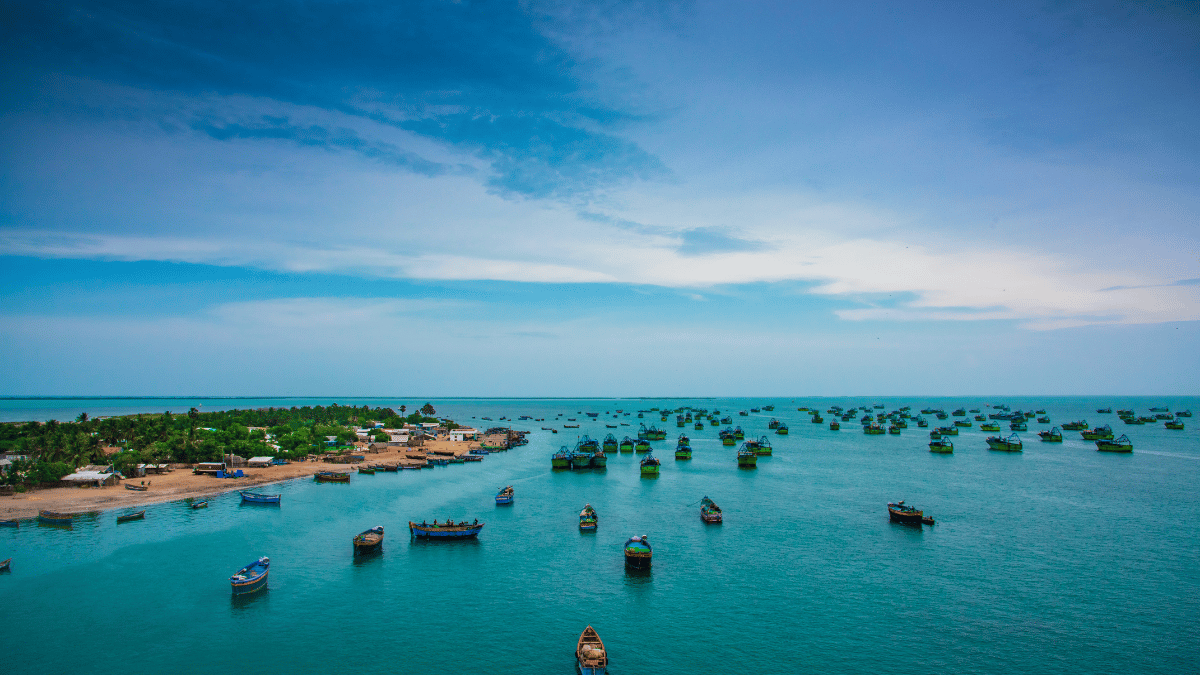
Rameshwaram is where the trip turns sacred in a different register. Sitting at the tip of the Pamban peninsula, connected to the mainland by the Pamban Bridge, one of the most dramatic railway bridges in India, Rameshwaram is one of the four dhams of Hinduism and is believed to be the place where Ram built his bridge to Lanka. The Ramanathaswamy Temple, with its extraordinary corridor of 1212 pillars, is the spiritual centrepiece. But Dhanushkodi, the ghost town at the very tip of the peninsula where the Bay of Bengal meets the Indian Ocean, is something else entirely. Abandoned after a catastrophic cyclone in 1964, it sits in a landscape of bleached ruins and vivid water that is like nowhere else on earth.
Thanjavur and Trichy bring the trip to its architectural and spiritual conclusion. The Brihadeeswarar Temple in Thanjavur, built by the great Chola king Rajaraja I in 1010 CE, is a UNESCO World Heritage Site and one of the greatest achievements of Indian architecture. Its vimana, the tower above the sanctum, rises 66 metres and was built without scaffolding, using an ingenious ramp system that no one has fully replicated since. The Srirangam Temple in Trichy is the largest functioning temple complex in the world, covering over 156 acres across seven concentric walls, its innermost shrine accessible only to Hindus and drawing pilgrims from across the country every day of the year.
This is Tamil Nadu in its full depth. Not a temple circuit but an immersion in a civilisation that is still very much alive, that still builds, still prays, still cooks, still carves, and still finds new ways to tell stories that are thousands of years old.