Seven days across the most beautifully compact island in South Asia Indian Ocean beaches, a UNESCO fort town, wild elephants at dawn, misty tea country, and a city that wraps it all up with a good meal and a warm send-off. Sri Lanka gives you everything at once.
Sri Lanka is small enough to cross in a day and rich enough to spend a lifetime in. That paradox is exactly what makes it one of the most satisfying travel destinations in the world and one of the most rewarding for a women-only group.
This seven-day journey moves along the south and central spine of the island, from the palm-fringed coast at Bentota to the tea estates of Nuwara Eliya, touching nearly every landscape Sri Lanka has to offer. You begin on the beach soft sand, warm Indian Ocean, a complete decompression from wherever you've come from. Then the route builds: a Madu River boat safari through mangrove islands rich with birdlife, the UNESCO-listed Galle Fort with its Dutch colonial lanes and ocean-facing ramparts, the famous Coconut Tree Hill at Mirissa, and a morning jeep safari at Udawalawa National Park where Sri Lankan elephants move in large, unhurried herds through open grassland.
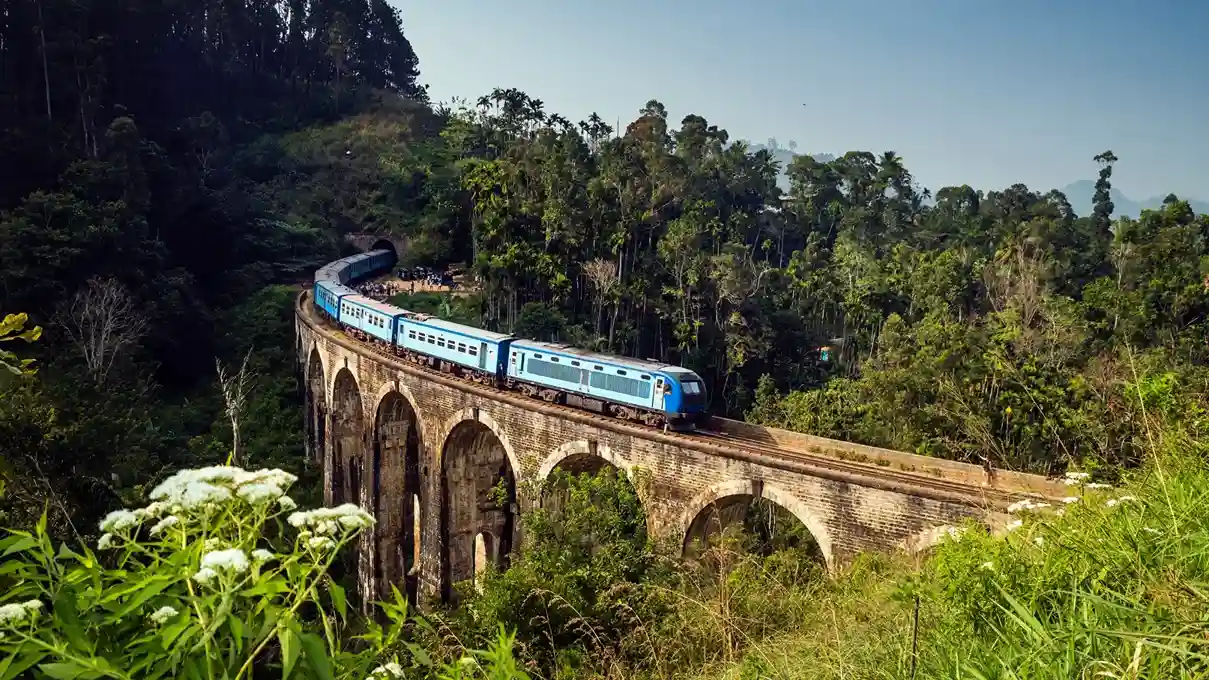
The midpoint is the hill country Ella and Nuwara Eliya, where the landscape switches from tropical coast to cool, misty highlands draped in tea. You stop at the Nine Arches Bridge, one of the most photographed railway structures in the world, and at Ramboda Falls before arriving in Nuwara Eliya fondly called Little England where the air feels genuinely different and the pace drops to something close to still. Day 6 brings you to Colombo for a tea plantation visit, the Gangaramaya Temple, Galle Face Green, and a final evening of shopping and cafés before the group disperses.
What makes Sri Lanka work so well for a women-only group is the combination of variety and ease. The distances are short, the transitions are scenic, the food is outstanding, and the country is safe and friendly in a way that lets you relax into every place you visit rather than staying alert. Eight UNESCO sites in a country roughly the size of Tamil Nadu the density of beauty here is genuinely remarkable.
Everything you might want to ask before you book this journey.
Yes, Indian passport holders require an Electronic Travel Authorisation (ETA) to enter Sri Lanka. The ETA is applied for online before travel and is straightforward to obtain typically approved within 24 hours. TFL will share detailed visa guidance with all confirmed participants. Do not book your flights before consulting the team on timings and requirements.
Galle Fort is a UNESCO World Heritage Site on the southwestern tip of Sri Lanka, built by the Dutch in the 17th century on earlier Portuguese fortifications. Within its rampart walls is a remarkably intact colonial town cobblestone streets, Dutch-era churches, boutique guesthouses, independent cafés, jewellery stores selling moonstones and sapphires, and ocean views from every corner of the walls. It is one of the most walkable, photogenic places in South Asia and a highlight of the entire route. Plan to spend at least two to three hours here.
Udawalawa is one of Sri Lanka's best national parks for elephant sightings the park is home to large resident herds of Sri Lankan elephants that are reliably visible because the habitat is open grassland rather than dense forest. An early morning jeep safari here is a genuinely moving experience. Alongside elephants you may also spot water buffalo, sambar deer, crocodiles, and a wide range of birds. Sightings are never guaranteed but Udawalawa has a significantly higher hit rate than most parks.
Nuwara Eliya is a hill town at 1,868 metres altitude in the central highlands of Sri Lanka, surrounded by some of the island's most famous tea estates. The British colonial-era architecture, cool temperature, rose gardens, and misty light give it a quality that feels genuinely unlike the rest of the island hence the nickname Little England. The drive up through Ella and past Ramboda Falls is one of the most scenic road journeys in Sri Lanka, and stopping at the Nine Arches Bridge is a must. A visit to a working tea plantation and factory on Day 6 gives you the full picture of how Ceylon tea goes from leaf to cup.
This trip moves from beach to jungle to highlands to city, so layers matter. Light cotton clothing for the coast and Colombo, a warm layer or light jacket for Nuwara Eliya evenings, comfortable walking shoes for fort walks and temple visits, and sandals or flip-flops for the beach. Modest clothing for temple visits is important covered shoulders and knees are expected. Sunscreen and a small daypack round out the essentials.
This is a moderately easy trip. The jeep safari at Udawalawa involves sitting in an open vehicle no walking required. The Galle Fort, Colombo, and Nuwara Eliya involve comfortable walking on paved surfaces. The Madu River boat safari is entirely seated. Whale watching involves a boat on open water which can be choppy, so if you are prone to seasickness, carry medication. There are no treks or strenuous physical activities on this itinerary.