Rajasthan is the kind of destination that people put on their list for years and then wonder why it took them so long once they finally go. There is nowhere else in India quite like it. The scale of its forts, the intensity of its colours, the richness of its food, the warmth of its people, and the sheer drama of its landscape combine into something that gets under your skin and stays there. This trip takes you through two of its most extraordinary cities, a road trip between them, and one night in the desert that you will be talking about for years.
Jaisalmer is where the trip begins and where it makes its first impression, which is a powerful one. The city rises from the Thar Desert like a mirage, its golden sandstone fort glowing amber in the late afternoon light, its havelis and temples and merchants’ houses all built from the same honey coloured stone that gives the city its name, the Golden City. The Jaisalmer Fort is one of the largest fully inhabited living forts in the world. People live inside it, as they have for centuries, and walking its lanes feels like stepping directly into medieval Rajasthan without a single concession to the present day. Patwon ki Haveli, an extraordinary cluster of five connected mansions built by a wealthy merchant family in the 19th century, is the finest example of Rajasthani domestic architecture you will see anywhere, its facade carved so intricately that it looks like stone lacework. Gadisar Lake, built in the 14th century as a water conservation reservoir and now ringed with temples and ghats, offers a quiet and completely different face of the city.
And then the desert camp. Transferring to the sand dunes at the edge of the city and spending a night in a tent under a Rajasthani sky, with camel rides over the dunes at sunset and traditional folk music and dance by firelight, is one of those travel experiences that simply cannot be replicated anywhere else. The desert at night is quieter than almost anything you will have experienced, and the stars over the Thar are extraordinary.
The drive from Jaisalmer to Jodhpur is itself part of the experience. The Rajasthani landscape shifts as you move east, from the deep desert to the rocky outcrops of the Aravalli foothills, and the road carries you through small towns, painted havelis, and camel crossings that make the journey as memorable as the destination.
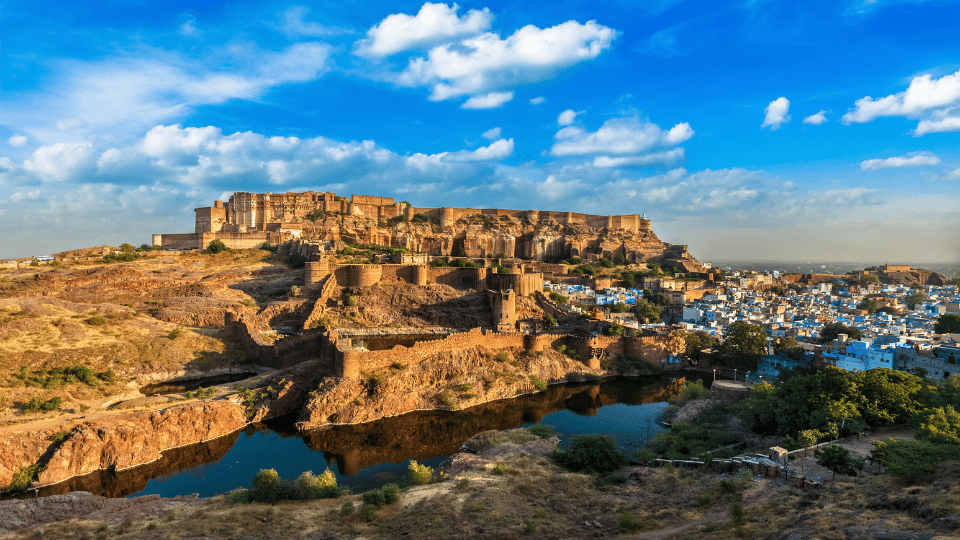
Jodhpur, the Blue City, is everything Jaisalmer is and something completely different at the same time. Where Jaisalmer is golden and desert born, Jodhpur is dramatic and volcanic, its old city spilling down the hillside below the enormous Mehrangarh Fort in a cascade of blue painted houses that looks from a distance like a river of indigo. The Mehrangarh Fort is one of the finest in India, its museum housing weapons, textiles, royal palanquins, and miniature paintings that tell the full story of the Marwar kingdom. Jaswant Thada, the white marble cenotaph complex built in 1899, is all stillness and filigree stone, the light through its marble panels creating an atmosphere of extraordinary peace. Umaid Bhavan, the art deco palace still partially occupied by the royal family, is a completely different register, grand and geometric and unexpectedly modern.
The heritage walk through the lanes of the old city, past blue washed walls, tiny temples, and bazaars selling textiles, spices, and silverware, gives you the Jodhpur that lives below the monuments. It is unhurried, intimate, and deeply enjoyable.
Rajasthan at the end of November is at its best. The heat has gone, the skies are clear, and the light is the colour of warm honey from morning to evening. There is no better time to see it.